When Your Garage Door Opener Won’t Respond: Getting Back in Control
Emergency garage door opener repair becomes critical when you’re rushing to work and your garage door won’t budge, or worse – when you’re stuck outside in harsh Minnesota weather. Here’s what to do immediately:
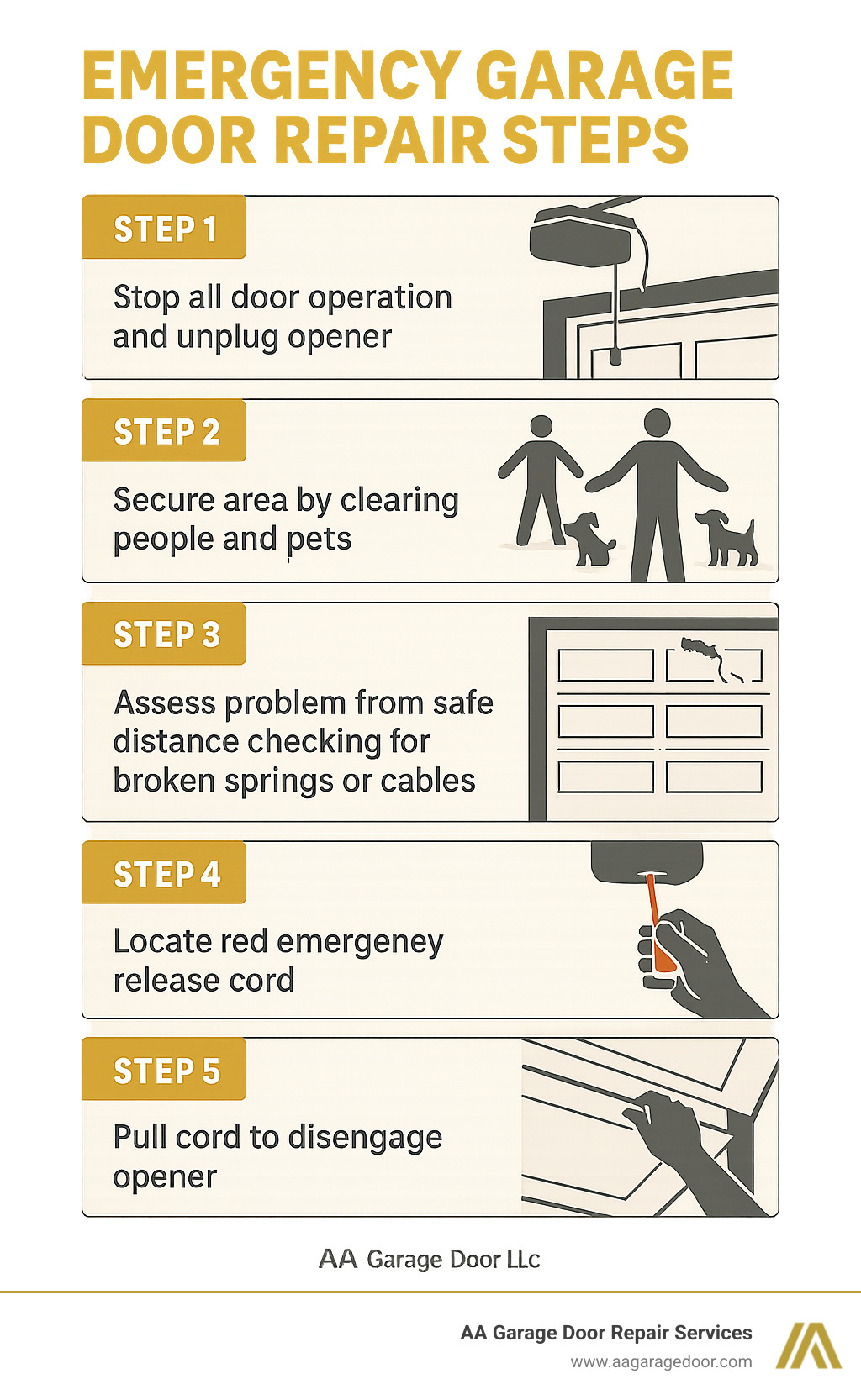
Quick Emergency Actions:
- Stop all attempts to operate the door
- Unplug the opener from the power source
- Clear the area of people and pets
- Locate the red emergency release cord hanging from the opener track
- Pull the cord down and back to disengage the opener
- Manually lift the door if safe to do so
Call a professional immediately if:
- The door feels extremely heavy to lift
- You see broken springs or frayed cables
- The door is stuck halfway open
You’re rushing out the door, late for work, and you hit the button to open your garage door. But instead of the familiar whirring sound, there’s silence. The automatic opener has malfunctioned, and the door is stuck firmly shut. This exact scenario happens to thousands of homeowners every day – and knowing how to respond can save you time, money, and frustration.
Whether it’s a power outage, mechanical failure, or worn-out components, garage door opener emergencies don’t follow your schedule. The good news is that most garage doors have built-in manual override systems designed for exactly these situations. However, safety must always come first when dealing with heavy doors and high-tension components.
For reliable garage door services in the Twin Cities area, professional help is just a phone call away when DIY solutions aren’t enough.
I’m David Sands, owner of AA Garage Door LLC, and in my 23+ years of experience, I’ve helped thousands of homeowners safely steer emergency garage door opener repair situations. From midnight power outages to broken springs during Minnesota’s harsh winters, I’ve seen every type of garage door crisis and know exactly what works – and what’s too dangerous to attempt alone.
First Steps: Safety Precautions Before You Touch Anything
When your garage door opener suddenly stops working, your first instinct might be to start poking around and see what’s wrong. Hold on right there! Before you touch anything, garage doors are heavy beasts – we’re talking 200 to 400 pounds of solid weight hanging over your head. Add in those high-tension springs and cables, and you’ve got a recipe for serious injury if things go sideways.
The golden rule of emergency garage door opener repair: When in doubt, safety first. Always.
Here’s what happened to one of my customers last winter – their door got stuck halfway open during a blizzard, and instead of calling for help, they tried to muscle it closed. The result? A bent track, damaged panels, and a very expensive repair bill that could have been a simple fix.
Do:
Stop using the door immediately if it’s acting up. I can’t stress this enough – a malfunctioning garage door that’s making weird noises or moving erratically is trying to tell you something’s wrong. Listen to it and cease all attempts to operate the door.
Unplug the motor from its power source. This is your safety net. When the opener is unplugged, it can’t suddenly spring to life while you’re inspecting things. I’ve seen too many close calls where someone thought the opener was broken, only to have it activate unexpectedly.

Keep the area clear of curious kids, pets, and well-meaning neighbors. Create a safety zone around your garage door until you figure out what’s going on. Trust me, you don’t want anyone nearby if something decides to snap or fall.
Call a professional for major issues – and by major, I mean anything involving broken springs, frayed cables, or doors that are completely off their tracks. These aren’t weekend DIY projects. For comprehensive safety guidelines that every homeowner should know, check out our garage door safety tips for homeowners.
Don’t:
Never stand under a stuck door, especially one that’s partially open. I’ve seen what happens when a door’s support system fails – it’s not pretty. That door can come down faster than you can blink, and there’s no “undo” button on a serious injury.
Don’t try to force the door open or closed. Pushing, pulling, or giving it the old “percussive maintenance” treatment will only make things worse. You might bend the tracks, crack panels, or burn out the motor – turning a $100 fix into a $500+ headache.
Absolutely do not attempt to repair springs or cables yourself. This is where things get dangerous fast. Those springs are under tremendous tension – enough to seriously hurt or kill someone if they snap unexpectedly. Even experienced DIYers should leave spring and cable work to the pros. It’s just not worth the risk to you or your family.
Emergency garage door opener repair situations are stressful enough without adding injury to the mix. Take a deep breath, follow these safety steps, and you’ll be back to normal operation safely.
How to Use the Emergency Release Cord: Your Manual Override
Picture this: it’s 6 AM, you’re running late for an important meeting, and your garage door opener has decided to take an unscheduled vacation. Before you start panicking or considering climbing through a window, take a deep breath. Every garage door opener comes equipped with a lifesaver – the emergency release cord. This simple red cord is your ticket to freedom when technology fails you.
The emergency release system is essentially a manual override that disconnects your garage door from the automatic opener. Think of it as the “manual mode” button on your washing machine – it bypasses all the fancy electronics and lets you do things the old-fashioned way. This feature becomes absolutely crucial during power outages, opener malfunctions, or any situation requiring emergency garage door opener repair.
Step-by-Step Guide to Emergency Garage Door Opener Repair Using the Release Cord
Finding your lifeline is the first step. Look up at your garage door opener track and you’ll spot a red rope or cord hanging down, usually positioned near the front of the opener closest to the door itself. This cord connects to a small lever on the trolley – that’s the part that rides along the track and actually moves your door up and down.
Before you pull anything, here’s a critical safety tip: try to ensure your door is fully closed first. If your door is stuck halfway open, pulling that cord could send several hundred pounds of door crashing down faster than you can say “oops.” If you absolutely must disengage an open door, make sure nobody – and I mean nobody – is standing underneath it.

Now for the magic moment: grip the red cord firmly and pull it straight down and slightly back toward the opener motor. You should hear a satisfying click – that’s the sound of the trolley mechanism disengaging from the drive system. Congratulations! You’ve just manually disconnected your door from the opener.
Manually Opening and Closing the Door
Here’s where things get interesting – and where you’ll find whether your garage door is properly balanced. A well-maintained door should feel surprisingly manageable to lift, even without the opener’s help. If it feels like you’re trying to bench press a small car, stop immediately – you likely have a broken spring situation that needs professional attention.
Proper lifting technique matters here. Position yourself at the center of the door, bend those knees, and lift with your legs, not your back. Your chiropractor will thank you later. Apply pressure evenly across the door’s width to prevent it from binding in the tracks. If the door fights you or feels lopsided, don’t force it.
Here’s a quick balance test that can save you future headaches: lift the door about halfway up and let go gently. A properly balanced door should stay put, not slam down or shoot up like a rocket. If it does either of those things, you’ve got spring issues that require professional expertise.
Need to keep the door open for a while? Secure it properly with sturdy clamps or locking pliers on the tracks just below the rollers. Never trust the emergency release alone to hold your door open – gravity always wins eventually.

Re-engaging the Garage Door Opener
Once your emergency is over and power is restored (or whatever caused the malfunction is fixed), you’ll want to reconnect your door to the opener. The good news? Modern garage door systems make this pretty straightforward.
Start with a closed door – this is absolutely essential for proper re-engagement. With the door fully lowered, you have a couple of options depending on your opener model. Some require you to pull that red cord again, while others will automatically reconnect when you hit the remote or wall button.
Listen for the reconnection. When the trolley slides back into position and locks onto the drive mechanism, you’ll hear a distinct click or clunk. It’s like the satisfying sound of a puzzle piece snapping into place. Give the door a gentle tug to make sure it feels securely attached to the opener.
Test everything thoroughly before calling it a success. Use your remote or wall button to cycle the door open and closed a few times. Listen for smooth, even operation and watch to ensure it opens and closes completely without hesitation or jerky movements.
If the trolley won’t re-engage or keeps disconnecting, don’t keep forcing it. Sometimes the alignment gets slightly off, or there might be an underlying issue with the opener mechanism itself. That’s when it’s time to call in the professionals rather than risk damaging your system further.
Troubleshooting Common Opener Failures
When the emergency release cord works fine but your opener still won’t cooperate, you’re dealing with an electrical or mechanical issue. Don’t worry – many opener problems have simple solutions you can try before calling for emergency garage door opener repair.
What to Check When the Opener is Unresponsive
Before you assume the worst, let’s walk through the most common culprits. I’ve seen countless homeowners feel embarrassed after finding their “broken” opener just needed fresh batteries!
Start with the power supply – yes, it sounds obvious, but you’d be surprised how often a loose plug or tripped circuit breaker is the villain. Check that the opener is firmly plugged in, then test the outlet with a lamp or phone charger. If there’s no juice, head to your electrical panel and look for a tripped breaker.
Remote control batteries are another frequent troublemaker. Those little batteries seem to die at the worst possible moments – usually when you’re running late or it’s pouring rain. Pop in fresh batteries and give it another try.
Wall control wiring can work loose over time, especially in older homes where vibration from the opener gradually loosens connections. Take a peek at the wiring where it connects to both the wall button and the opener motor. Look for any obviously loose or damaged wires.
Safety sensor alignment is probably the trickiest issue to diagnose. These little electronic eyes sit near the bottom of your door tracks and create an invisible beam. If something blocks this beam – even a spider web or accumulated dust – your door won’t close properly.
Check if the indicator lights on both sensors are glowing steadily. If they’re dark or blinking, gently clean the lenses with a soft cloth and make sure they’re pointing directly at each other. Sometimes a small bump from a lawn mower or snow shovel can knock them out of alignment. For more detailed troubleshooting on these finicky components, check out our guide on common reasons for garage door sensor troubles.
Signs Your Garage Door Opener Needs Emergency Garage Door Opener Repair
Sometimes your opener gives you warning signs before it completely gives up the ghost. Recognizing these red flags can help you avoid getting trapped in your garage or locked out of it.
Grinding or squealing noises are never a good sign. If your opener sounds like it’s auditioning for a horror movie soundtrack, you’re likely dealing with worn gears, a struggling motor, or other internal mechanical problems. These sounds often get progressively worse before the opener fails completely.
Slow or hesitant operation is another telltale sign of trouble. A healthy opener should move your door smoothly and confidently. If it’s moving like it’s stuck in molasses, the motor might be weakening or internal components could be wearing out under the strain of lifting your door.
Door reverses on its own – this one’s particularly frustrating and potentially dangerous. When your door starts closing but then suddenly reverses without hitting anything, it could mean faulty safety sensors, incorrect force settings, or even structural issues like misaligned tracks or broken springs putting extra stress on the opener. This behavior definitely warrants professional attention. Learn more about this puzzling problem in our article on why your garage door opens or closes by itself.
Age matters too – if your opener is over 10 to 15 years old, it’s entering its golden years. Like any hardworking appliance, garage door openers have a finite lifespan. Older units also lack modern safety features and energy efficiency, making replacement often more sensible than repeated repairs.
Frequent malfunctions are perhaps the most maddening sign of all. When your opener works sometimes but not others, with no apparent pattern, you’re dealing with an underlying problem that’s getting worse. Don’t wait for it to fail completely when you’re rushing to an important meeting!
When to Call for Professional Emergency Garage Door Opener Repair
While it’s tempting to channel your inner handyperson when faced with a malfunctioning garage door, there are times when stepping back and calling in the experts is not just the smart choice – it’s the safe one. Emergency garage door opener repair often involves complex systems that require specialized knowledge and tools.

DIY repairs might seem like a money-saving solution, but garage door systems are deceptively complex. What looks like a simple fix can quickly turn into a dangerous situation. The door itself can weigh 150-400 pounds, and the mechanisms that move it are under tremendous stress. One wrong move can result in serious injury or expensive damage that far exceeds the cost of professional repair.
Electrical hazards are another major concern. Modern garage door openers are sophisticated electrical devices with safety circuits, force adjustments, and complex wiring. Unless you’re a qualified electrician, tampering with these components can lead to shock, fire, or permanent damage to the system.
The biggest danger lies with high-tension springs. These components are wound tight enough to lift hundreds of pounds, and when they fail or are mishandled, they can cause devastating injuries. We’ve seen too many DIY attempts gone wrong – broken bones, damaged property, and worse. This is why we always recommend professional service for spring-related issues.
Voiding warranties is another costly risk. Most manufacturers require certified technician installation and repair to maintain coverage. That weekend project could end up costing you thousands in voided warranty protection.
For expert garage door opener repair, it’s best to call a certified technician who has the training, tools, and experience to handle these complex systems safely. Professional technicians can quickly diagnose problems that might take homeowners hours to figure out – if they can figure them out at all.
The good news? Many garage door companies offer 24/7 emergency services because we understand that garage door problems don’t wait for business hours. Whether it’s a broken spring at midnight or an opener that fails during a snowstorm, professional help is available when you need it most.
Spring repairs are particularly dangerous and should never be attempted as DIY projects. Our article on 3 reasons to have damaged garage door springs professionally replaced explains exactly why this work requires professional expertise.
Frequently Asked Questions about Emergency Opener Issues
After helping thousands of Twin Cities homeowners through garage door crises over the past two decades, I’ve noticed the same questions come up again and again. Here are the answers to the most pressing concerns I hear when families are facing emergency garage door opener repair situations.
What should I do if the garage door is too heavy to lift after pulling the release cord?
This is one of those moments that makes my phone ring at 2 AM – and for good reason. When your garage door feels like it weighs a ton after disconnecting the opener, you’re likely dealing with broken springs. These springs are the unsung heroes of your garage door system, designed to counterbalance hundreds of pounds so effortlessly that you barely notice them working.
Here’s the thing: a properly functioning garage door should feel surprisingly light when you lift it manually, even with the opener disengaged. If it feels like you’re trying to bench press a small car, stop immediately. Don’t try to muscle it open – you could seriously injure your back, or worse, the door could come crashing down unexpectedly.
This situation screams for immediate professional attention. Broken springs aren’t a “maybe tomorrow” problem – they’re a safety hazard that needs addressing right away. That’s exactly why companies like ours offer 24-hour garage door service. We’ve seen too many homeowners get hurt trying to force a door with broken springs.
Why is my garage door opener making a humming noise but not moving the door?
Ah, the dreaded “hum of doom” – that’s what we call it in the trade! A humming motor that refuses to budge the door usually points to stripped gears inside the opener unit. Think of it like a car that revs but won’t move because the transmission is shot.
Sometimes the issue is simpler – the trolley might have become disconnected from the opener’s drive system. You can check this by looking at the emergency release cord area and seeing if the trolley is properly engaged. If it looks disconnected, try the re-engagement process we covered earlier.
But if the motor hums, the trolley looks connected, and nothing’s moving, you’re likely looking at internal gear damage. This happens over time as the plastic or metal gears inside the opener wear down from years of lifting your heavy garage door. Unfortunately, this isn’t a YouTube tutorial kind of fix – it requires taking apart the opener motor and replacing precision-engineered components.
Can I fix the emergency release cord myself if it breaks?
The short answer is: it depends on what exactly is broken. If it’s just the rope that’s frayed or snapped, replacing that is usually straightforward – you can pick up a replacement cord at most hardware stores.
However, here’s where things get tricky. Often, when the cord breaks, it’s not just the rope itself – it’s the mechanism it connects to on the trolley that’s failed. A broken or damaged release mechanism is a serious safety concern because it means you might not be able to manually operate your door during an emergency or power outage.
I’ve seen too many homeowners replace the rope only to find that the actual release lever is bent, broken, or seized up. When that happens, you might think you’ve fixed the problem, but you haven’t – and you won’t find out until you really need that manual override to work.
The release system needs to function flawlessly when you need it most – during storms, power outages, or when your opener completely fails. That’s why we always recommend having a qualified technician inspect the entire release mechanism, not just replace the visible rope. It’s one of those “better safe than sorry” situations that could save you from being trapped in or out of your garage when you least expect it.
Your Local Solution for Garage Door Emergencies
Knowing how to use the emergency release is a vital skill for any homeowner. However, for issues involving broken parts, electrical systems, or the door’s balance, safety must come first. Attempting complex DIY repairs can lead to severe injury or further damage. Issues like worn rollers, broken springs, or faulty garage door openers are often cited as common problems that may require professional repair.
The truth is, while we’ve armed you with the knowledge to handle basic emergency situations, there’s a fine line between what you can safely tackle yourself and what requires professional expertise. Broken springs can snap without warning, sending metal flying at dangerous speeds. Electrical issues with your opener can pose fire hazards or electrocution risks. Door balance problems might seem minor but can quickly escalate into major safety concerns.
At AA Garage Door Repair Services, we understand that garage door emergencies don’t wait for convenient hours – they happen at 6 AM when you’re rushing to work, or at midnight during a Minnesota snowstorm. Since 2001, we’ve been the go-to solution for residents throughout St. Paul, the Twin Cities, and Western WI who find themselves facing these exact situations.
Our experienced technicians have seen it all – from springs that gave up the ghost during the coldest week of winter to openers that decided to quit working right before a big family gathering. We’re available 24/7 to tackle any emergency garage door opener repair with transparent pricing and a satisfaction guarantee. No surprise fees, no hidden costs – just honest service when you need it most.
The reality is that garage door emergencies rarely happen at convenient times. That’s why we’ve built our reputation on being there when other companies have closed up shop for the day. Whether it’s a complete opener failure, a door stuck halfway open with your car trapped inside, or a spring that’s snapped and left your door dangerously unbalanced, we’re equipped to handle it safely and efficiently.
If you’re facing a garage door crisis, don’t hesitate to contact our experts for emergency garage door repair. We’re here to get you unstuck, safely and efficiently – because your garage door emergency is our priority, no matter what time the clock shows.