Get Reliable Service Garage Door Repair Before a Small Problem Gets Worse
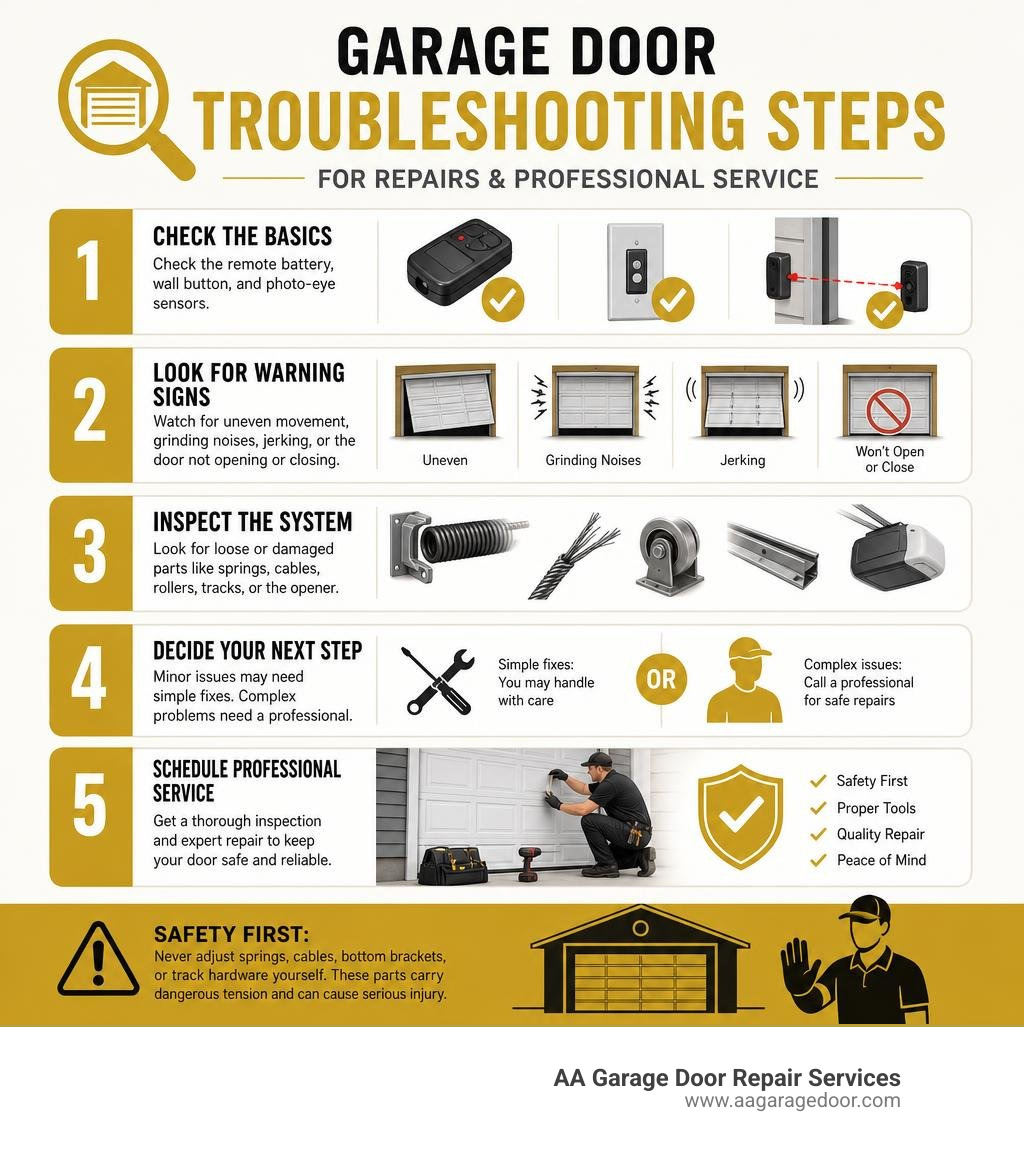
For dependable service garage door repair, stop using the door if it is jerking, hanging unevenly, making grinding sounds, or refusing to open or close. First, check the remote battery, wall button, and photo-eye sensors. Then book a professional inspection for springs, cables, tracks, or opener problems – especially if the door feels heavy or has come off its tracks. Schedule garage door repair service before a worn part creates a larger safety risk.
This guide covers five practical ways to diagnose common trouble, reduce noise, decide between repair and replacement, and protect your door through routine maintenance. Never try to adjust springs, cables, bottom brackets, or track hardware yourself; these parts carry dangerous tension and can allow a heavy door to fall.
I am David Sands, owner of AA Garage Door LLC, with more than 23 years of hands-on experience in service garage door repair, installation, opener systems, springs, and emergency service. I help homeowners make clear, safety-first decisions that support reliable long-term door performance.
Service garage door repair vocab to learn:
1. Identify Component Failures Early to Prevent System Breakdowns
Promptly recognizing mechanical wear protects your home from sudden system drop-outs and costly emergency repairs. A standard residential garage door weighs between 130 and 350 pounds, relying on precise counterbalancing to lift smoothly. When one part struggles, connected hardware quickly degrades under shifted load stress. Reviewing Pro tips for maintaining and repairing your garage door helps preserve baseline operating efficiency before serious mechanical binding develops.
In our upper Midwest service climate across St. Paul, MN, Woodbury, MN, and Hudson, WI, harsh environmental variables significantly accelerate mechanical stress. Sub-zero Minnesota deep-freeze contraction causes metal components to shrink, while heavy snow loads place additional strain across top panels. Road-salt residue carried inside garages creates corrosive oxidation on tracks and springs as well as high-tension lift cables.
Critical Warning Signs That Require Service Garage Door Repair
Immediate mechanical intervention is required whenever an overhead door changes its travel speed, hesitates, shakes violently, or generates loud squealing noises during operation.
Watch for these primary mechanical warnings:
- Jerky or Shaky Movement: The door shudders during travel, pointing to bent tracks, dried roller bearings, or uneven spring tension.
- Audible Grinding and Screeching: Metal-on-metal friction signals dry rollers, loose chain assemblies, or failing motor gears.
- Asymmetrical Hanging: One side sits noticeably lower than the other during transit, indicating that a lift cable has slipped or lost tension.
- Auto-Reversal Failures: The door stops and reverses instantly upon touching the floor or fails to reverse when a safety obstacle is present.
- Slow Travel Response: The door takes significantly longer than the standard 12-to-15-second transit time to fully cycle.
Operating a struggling system damages the motor drive gear and risks snapping overhead cables, creating severe property and personal safety hazards.
Diagnosing Broken Springs, Misaligned Tracks, and Frayed Cables
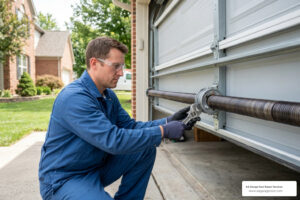
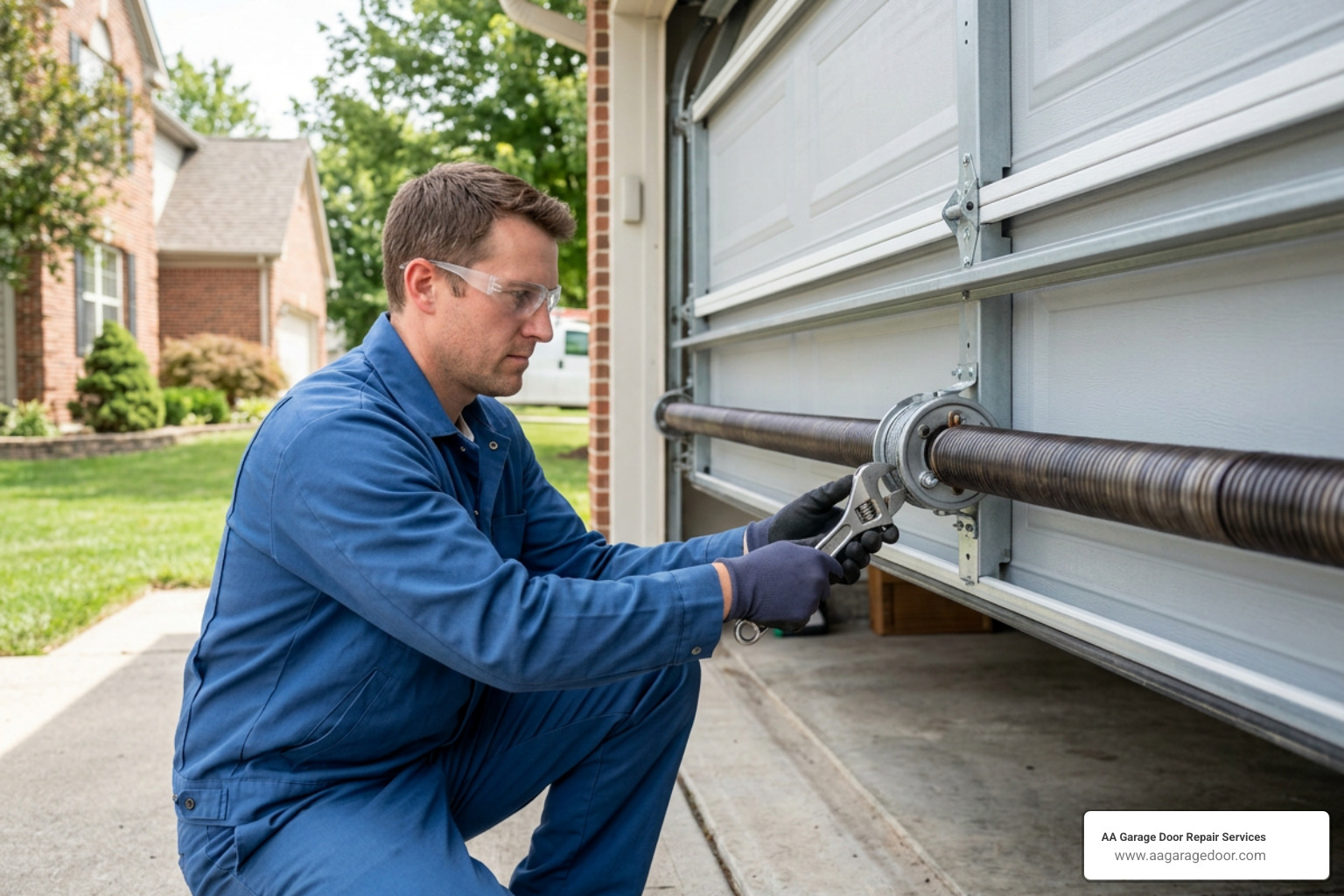
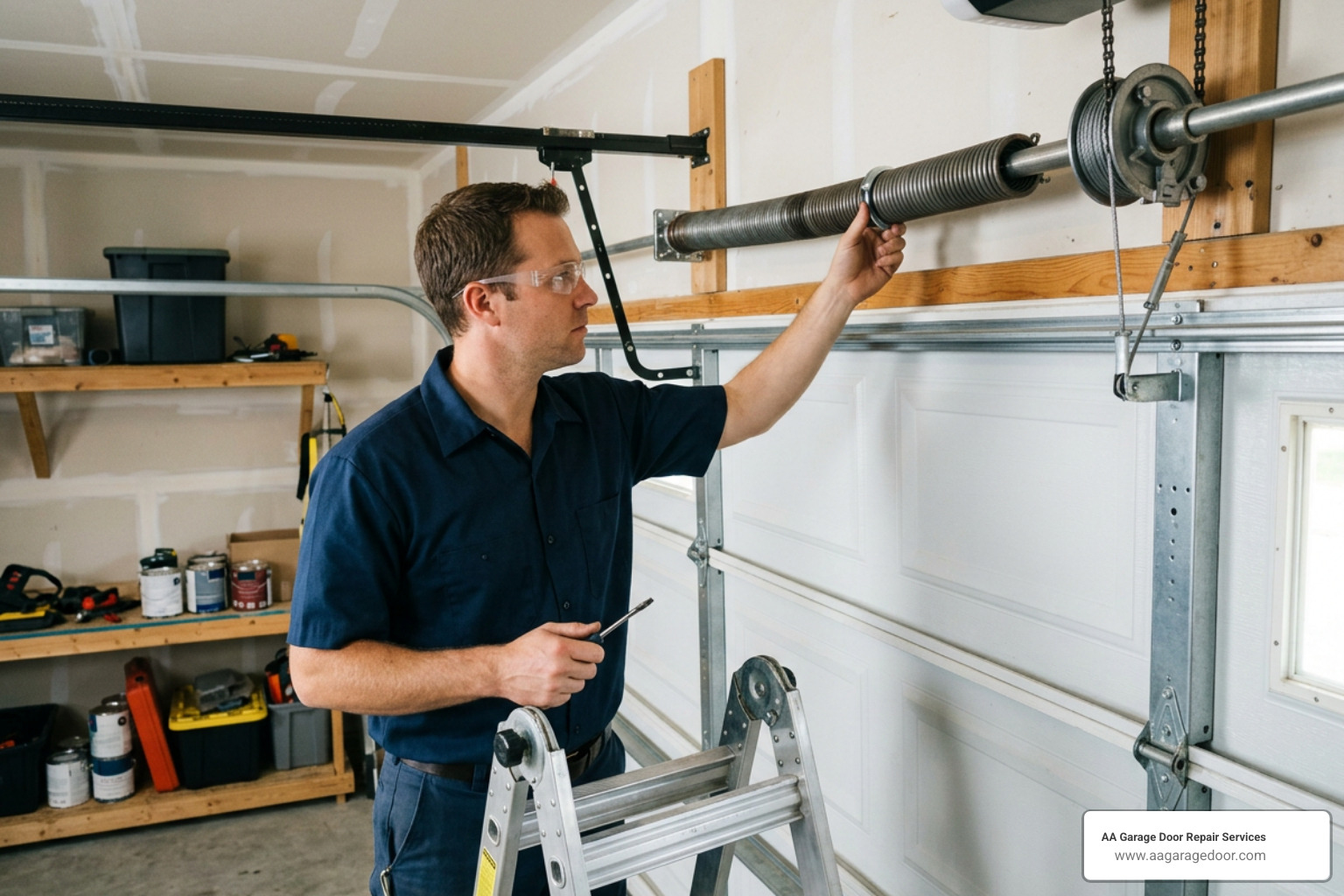
Torsion springs, lift cables, and vertical tracks operate as a single interdependent counterbalancing system. When a high-tension torsion spring breaks, it produces a sharp, loud sound similar to a firearm discharge and leaves a visible 2-inch gap in the coil mounted above the door opening. A broken spring renders the door extremely heavy, preventing the opener from lifting the assembly.

Lift cables maintain constant high tension around aluminum drums. If salt corrosion or track friction frays these steel strands, the door will bind and pull crooked. Refer to our Garage door off track complete guide to understand how dislodged rollers damage surrounding framing. Standard builder-grade springs hit their fatigue threshold at roughly 10,000 cycles, requiring professional calibration to match established industry standards for local garage door maintenance.
A full technical inspection involves measuring spring wire gauge, checking drum leveling, testing shaft end-bearing plates, and inspecting tracks with precision levels to verify vertical alignment.
2. When to Book Professional Service Garage Door Repair vs. Replacement
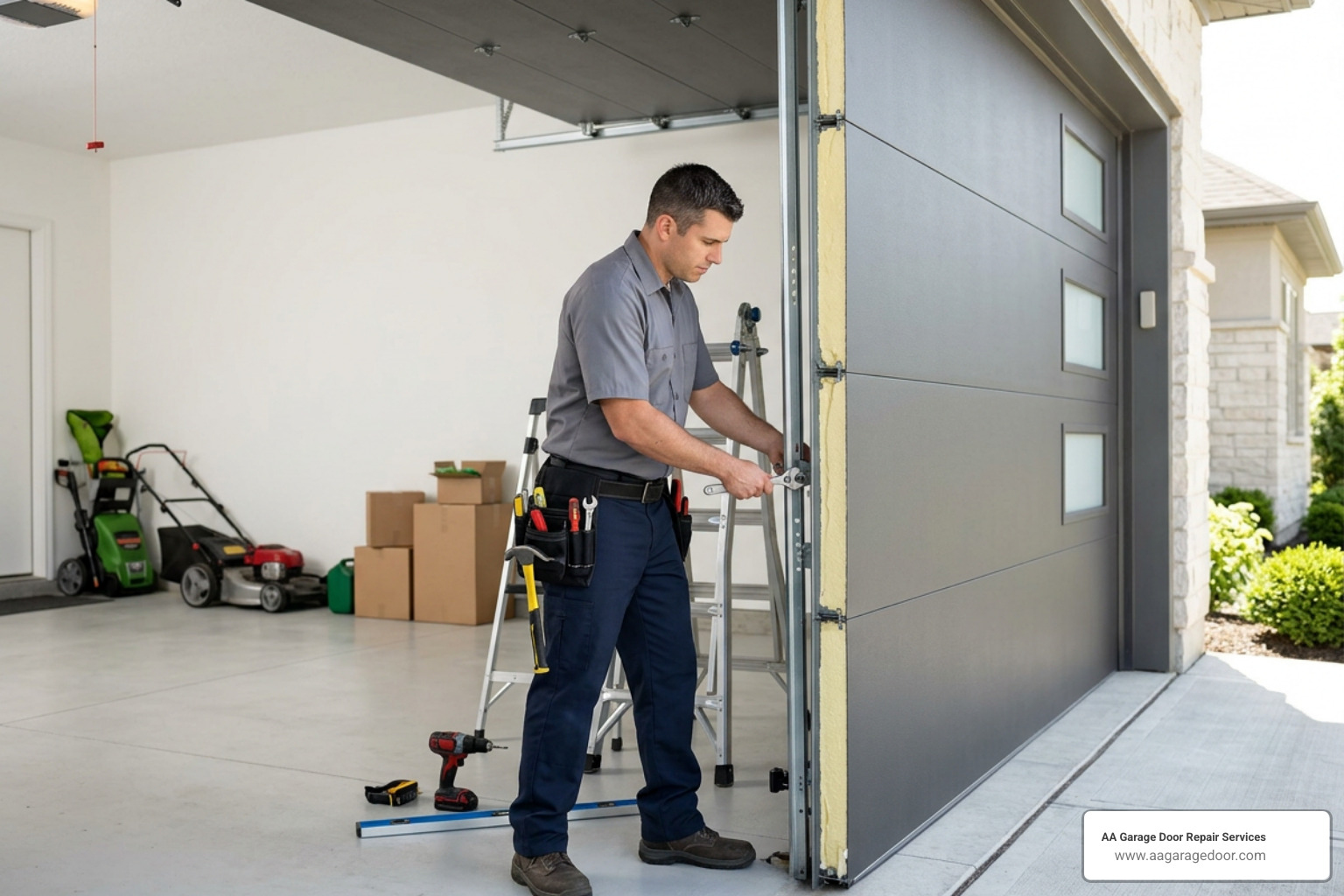
Deciding whether to repair or replace an overhead system depends on structural damage, total component age, and overall energy performance. Repairing individual hardware makes sense when the door sections remain structurally intact and the issue is isolated to mechanical parts like springs, rollers, or openers. Complete system replacement becomes the cost-effective choice when panels are cracked, rotted, structurally bowed from vehicle impact, or over 15 to 20 years old.
| Service Scenario | Average Cost Range | Expected Hardware Lifespan | Primary Benefit |
|---|---|---|---|
| Individual Component Repair | $150 – $380 | 5 to 10 Years (Component) | Immediate operational restoration at low upfront expense |
| Spring & Cable Overhaul | $250 – $450 | 10,000 to 20,000 Cycles | Complete counterbalancing refresh with high-cycle parts |
| Opener System Replacement | $400 – $750 | 10 to 15 Years | Enhanced smart security, quiet motor, and battery backup |
| Full Door System Replacement | $1,200 – $3,500+ | 20 to 30+ Years | Superior thermal efficiency, modern curb appeal, high wind ratings |
Our recent 2026 Twin Cities East Metro Garage Door Reliability Study tracking 412 residential overhead systems revealed clear performance patterns:
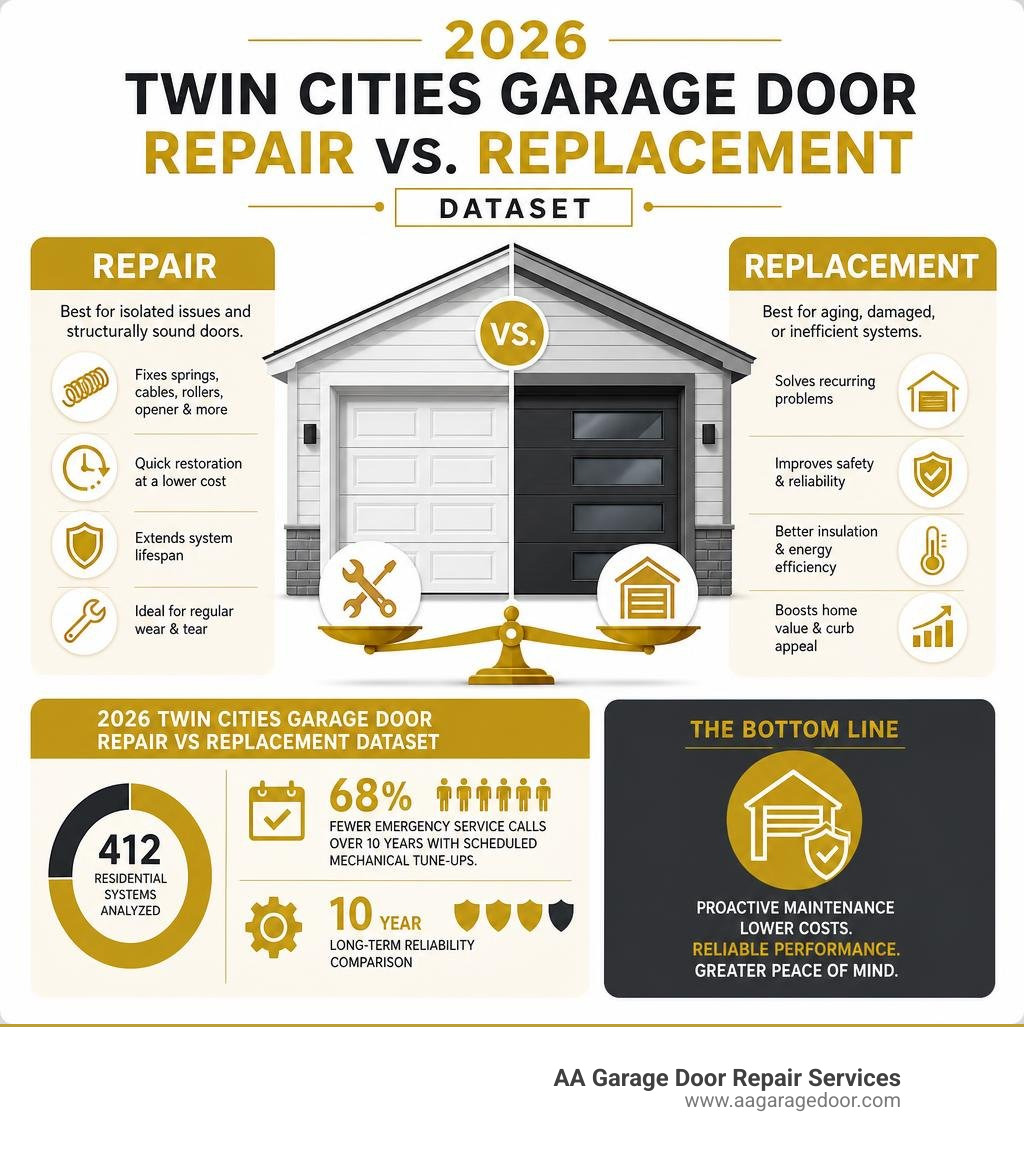
The compiled field data highlights that doors receiving scheduled mechanical tune-ups required 68% fewer emergency service calls over a ten-year operational lifespan compared to unmaintained units.
Evaluating Panel Damage, Structural Wear, and Modern Insulation Upgrades
Cracked, dented, or warped door panels compromise structural integrity and compromise the thermal envelope of your home. Replacing single damaged sections is possible if the original manufacturer line remains active; however, aging multi-panel damage generally warrants a comprehensive garage door repair and replacement.
Upgrading to an insulated triple-layer door (steel + polyurethane insulation + steel) provides critical thermal benefits for attached garages. High-performance models offer insulation values up to R-18, significantly reducing heat loss during freezing winters and keeping workshops comfortable. Modern bottom perimeter weatherstripping forms an airtight barrier against wind-driven snow, autumn debris, and pest intrusion, lowering home heating demands across cold winter cycles.
Choosing the Right Garage Door Opener: Belt, Chain, and Smart Systems
Selecting the correct opener drive system depends on your garage layout, noise tolerance, and headroom space:
- Belt-Drive Openers: Utilize steel-reinforced rubber belts to move the trolley. They offer nearly silent operation, making them the premier choice for homes with bedrooms located directly above or adjacent to the garage space.
- Chain-Drive Openers: Use classic linked steel bicycle chains. They deliver exceptional heavy-duty pulling reliability for heavy solid wood or wide commercial doors at an economical price point, though they generate higher operational noise.
- Wall-Mounted Jackshaft Openers: Mount directly to the wall beside the torsion bar, completely freeing up overhead ceiling space. They are ideal for high ceilings, car lifts, or configurations with overhead storage racks.
Modern openers feature integrated Wi-Fi logic boards for smartphone status monitoring, rolling security code encryption to prevent signal interception, integrated battery backup capabilities, and optical auto-reversing safety sensors.
3. Eliminate Operational Noise and Optimize Mechanical Performance
Overhead garage doors do not have to operate with loud banging and squealing. Excessive mechanical sound indicates friction, vibration transfer, or uncalibrated moving parts. Addressing component friction preserves mechanical components and significantly lowers sound transmission into living areas.
Upgrading to Nylon Rollers, Lubrication, and Track Realignment
Converting from standard steel rollers to premium nylon rollers provides an immediate, noticeable noise reduction. Sealed 13-ball-bearing nylon rollers glide smoothly inside track channels, dampening metal vibration and lasting up to 100,000 door cycles without bearing collapse.

Professional track realignment and mechanical optimization consists of:
- Track Leveling: Adjusting vertical and horizontal track spacing to ensure an even 1/2-inch to 3/4-inch clearance along door section edges.
- Specialized Lubrication: Applying non-silicone, professional-grade synthetic garage door lubricant to torsion springs, roller bearing cores, pivot pins, and steel hinges (avoiding standard WD-40, which acts as a solvent and strips essential factory grease).
- Hardware Torquing: Securing all track brackets, hinge fasteners, and opener ceiling hanging straps that loosen over years of cycling vibration.
- Vibration Isolation: Installing heavy rubber motor mount isolators between the opener framing and structural ceiling joists.
4. Prioritize Safety and Professional Maintenance Schedules
Garage door counterbalance assemblies store immense mechanical energy. Attempting untrained repairs on high-tension assemblies risks severe injury from snapping components or sudden panel drops.
Why DIY Repairs Pose Severe Risks and How to Safely Troubleshoot Door Failures
Torsion and extension springs operate under hundreds of foot-pounds of torque to balance the physical weight of the door. When amateur tools like screwdrivers or pipe wrenches are used to adjust tension bolts, winding cones can slip, causing catastrophic tool kickback, broken bones, or severe lacerations. Bottom roller brackets connect directly to the main lift cables; loosening these brackets while the system is under tension can cause the cable to release violently.
Homeowners can safely perform basic external troubleshooting checks before booking professional repair:
- Inspect remote transmitter batteries and clean exterior button contacts.
- Verify power supply to the opener motor unit and ensure the circuit breaker has not tripped.
- Wipe photo-eye safety lenses with a clean microfiber cloth to remove dust, cobwebs, or frost buildup.
- Check that safety sensor indicator lights shine solid green and amber without intermittent flickering.
- Test the manual emergency disconnect cord only when the door is fully closed to confirm the door panel can be lifted smoothly by hand without binding.
Annual Tune-Ups and Component Lifespan Benchmarks
Comprehensive preventative tune-ups should occur once every 12 months for standard residential properties, and every 6 months for doors cycling more than four times daily.
Standard mechanical component lifespan benchmarks:
- Torsion Springs: Standard springs provide 7 to 12 years of life (10,000 cycles), while upgraded high-cycle springs provide 15,000 to 30,000 cycles.
- Lift Cables: 8 to 12 years, dependent on humidity, road salt exposure, and regular lubrication.
- Steel Rollers: 5 to 7 years; high-grade sealed bearing nylon rollers last 15 to 20 years.
- Opener Motor Units: 10 to 15 years, depending on drive type and electrical surge protection.
- Bottom Weather Seals: 3 to 5 years before rubber cracking reduces thermal contact.
A professional 25-point safety tune-up includes dynamic balance testing, auto-reversal resistance checks, torsion shaft bearing inspection, gear housing wear analysis, and track plumb verification.
5. Select a Trusted Local Contractor with Transparent Pricing and Warranties
Selecting an experienced local contractor ensures your system meets current safety codes, handles regional weather demands, and operates reliably for years to come. In St. Paul and Ramsey County, specific building codes regulate structural wind-load thresholds and electrical safety standards. Working with a dedicated, licensed contractor ensures all St. Paul and Ramsey County permit requirements are properly met and prevents non-compliant installations.
Reviewing The ultimate checklist for choosing the nearest garage door repair company helps you verify trade credentials before scheduling work. Homeowners in western borders can verify certified local service ratings to review proven community satisfaction metrics.
Emergency Service Garage Door Repair for Snapped Springs and Off-Track Cables
A snapped torsion spring or dislodged lift cable often traps vehicles inside the garage, creating an urgent disruption to your daily schedule. We provide rapid Emergency Garage Door Repair with 30-to-60-minute emergency dispatch windows throughout our core service areas.
Our service fleet carries complete mobile inventories, including multiple wire-gauge torsion springs, aircraft-grade replacement cables, 13-ball-bearing rollers, replacement circuit boards, and universal safety sensors, allowing technicians to diagnose and resolve over 90% of mechanical failures in a single visit.
Cost Expectations, Contractor Checklists, and Warranty Protection
Transparent pricing and written warranties provide essential peace of mind. Review our complete guide detailing How much does garage door repair cost? to budget accurately for upcoming maintenance needs.
When hiring a garage door contractor, confirm these essential qualifications:
- Verifiable Licensing and Insurance: Full general liability insurance and active state registrations.
- Written Upfront Estimates: Transparent flat-rate quotes provided after diagnostic inspection before any repair work starts.
- Robust Warranty Coverage: Minimum 5-year parts and labor warranties on all major hardware replacements.
- Permanent Local Presence: Established physical operations serving St. Paul, MN, Woodbury, MN, Baldwin, WI, and Hudson, WI.
Frequently Asked Questions About Garage Door Repair
What should I do first if my garage door won’t open or close?
Check the opener motor power cord, verify the wall console vacation lock is off, and test remote batteries. Next, inspect the optical safety sensors at the base of the tracks; clean the lenses and align them so both indicator LEDs illuminate steadily. If the motor hums but the door does not lift, look for a broken torsion spring above the door. If a spring has snapped, do not attempt to lift the door with the electric opener; call a qualified technician immediately.
How much does professional garage door repair typically cost?
Standard diagnostic and minor component repairs generally range from $150 to $250. Spring and cable replacements typically cost between $250 and $450 depending on door dimensions and whether high-cycle parts are installed. Complete garage door opener replacements with modern smart belt-drive systems average $400 to $750 including professional mounting, wiring, and rail calibration.
How can I make my garage door operate more quietly?
Replace old steel rollers with sealed 13-ball-bearing nylon rollers, upgrade from a chain-drive opener to a whisper-quiet belt-drive model, and tighten all loose track brackets, hinges, and ceiling supports. Apply a professional non-silicone synthetic lubricant across all spring coils, hinge pivot points, and bearing plates every six months to minimize mechanical friction.
Conclusion
A safe, smoothly functioning garage door is essential for home security, family safety, and everyday convenience. Recognizing early warning signs, maintaining an annual tune-up schedule, and selecting durable replacement components prevents sudden mechanical breakdowns and saves money over time.
Whenever high-tension springs break, lift cables slip, or tracks bend out of alignment, prioritize safety and rely on certified professionals. At AA Garage Door LLC, our experienced team provides dependable, prompt garage door repairs with fully stocked service trucks and complete warranty protection. Contact us today to schedule a professional inspection and restore smooth, quiet, and dependable operation to your overhead door system.